Analog Mastering
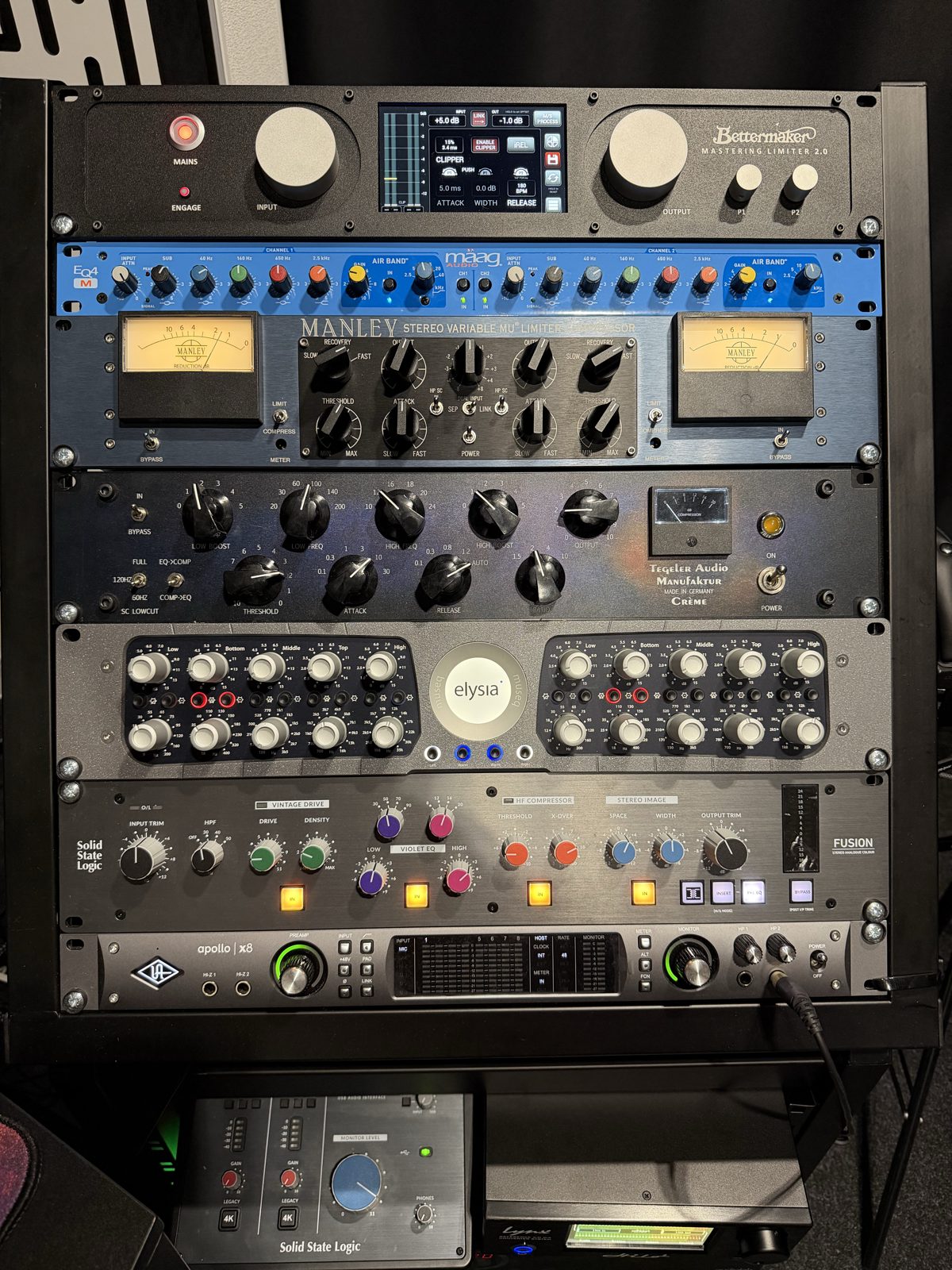
Your track, mastered by a human engineer on real analog hardware — Manley tube compression, Maag and Elysia EQs, SSL analog colour. No presets, no AI chain: a dedicated pass for your record with warmth digital can't fake.
✓ 100% removal of AI artifacts — your track is physically re-recorded through the analog chain
Hear the difference
The same track, before and after an analog mastering pass. Press play and flip the switch — both versions run in sync, so you switch on the same bar of music, not between two separate listens.
Premaster requirements
- WAV file only — 16 or 24-bit, any sample rate.
- Peaks no higher than −6 dBFS across the whole mix — mix your premaster so the loudest peak stays at −6 dB.
- Clean master bus — no limiter, clipper, or any plugins that colour or distort the sound.
Why −6 dB? That headroom is the space the analog chain works in — compression, EQ and final limiting happen on our side. A slammed premaster leaves the hardware nothing to do. We bring your track to its final release level ourselves: peaks at around −0.1 dB and loudness at around −7 LUFS — loud, competitive and clean.
Send us your track
How it works
What you get
- Mastered on real analog hardware, not plugins
- 100% removal of AI artifacts — the analog pass creates a brand-new recording
- 24-bit WAV master, ready for distribution
- Final level: peaks ~−0.1 dB, loudness ~−7 LUFS — competitive for streaming and club play
- One free revision round included
- 1–3 day turnaround
- Personal feedback from the engineer on your mix
Our Equipment
Professional analog mastering chain — the signal path your track deserves.
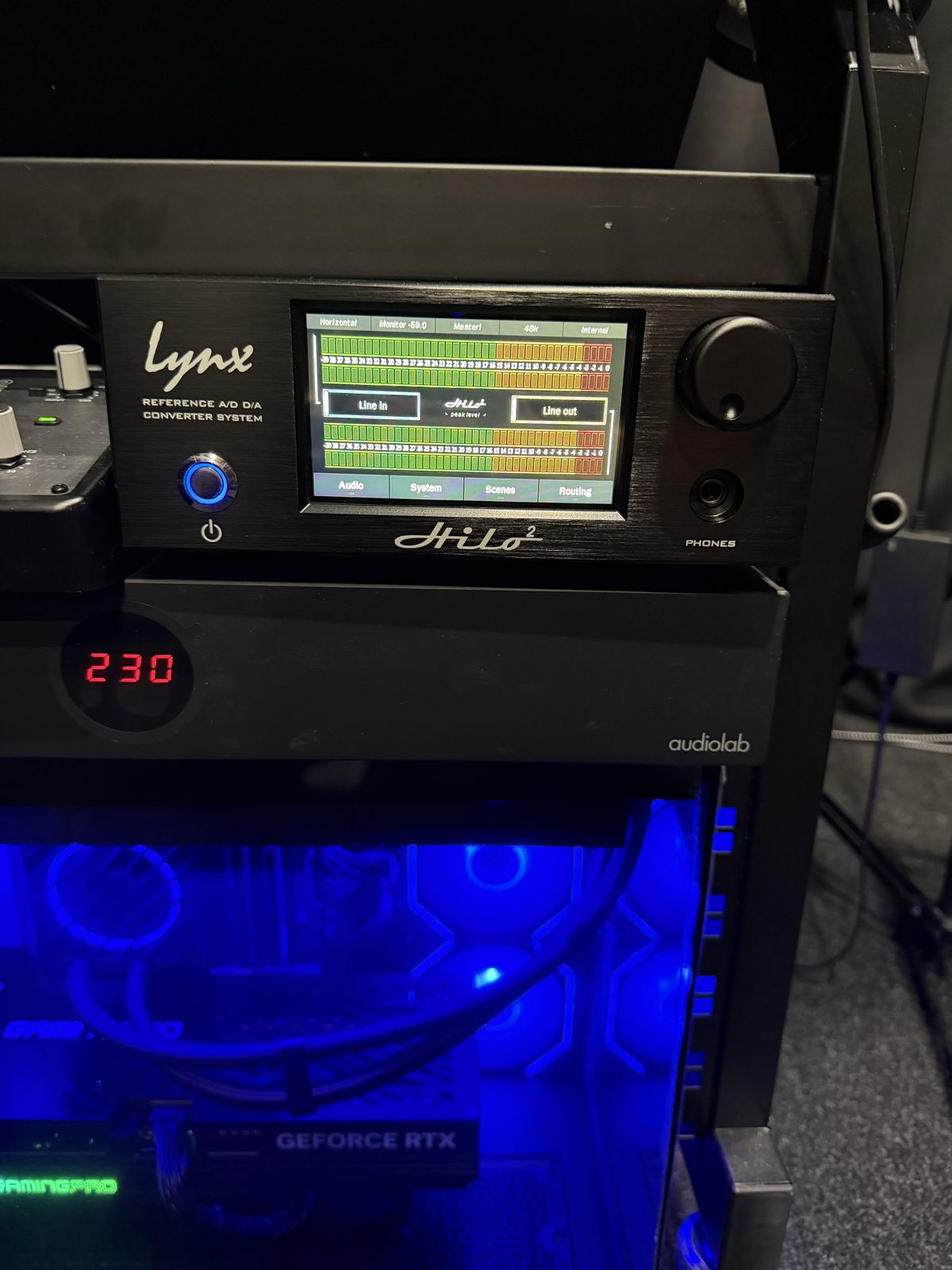
The heart of our signal chain. The Hilo 2 delivers Hi-End analog-to-digital conversion with THD+N < 0.001%, 122dB dynamic range on input and 127dB on output, 24-bit/192kHz resolution. Every detail of your mix enters and exits the analog domain with full transparency — no coloration, no compromise.
Analog signal path, digital precision control. Frequency response 10Hz–50kHz, THD < 0.01%, recall precision ±0.1dB. Brings your master to competitive loudness without killing dynamics — loud, clean, and musical.
Six bands of tonal shaping, crowned by Maag's legendary Air Band selectable at 2.5 / 5 / 10 / 15 / 20 / 40kHz. Frequency range 20Hz–40kHz. Shapes the frequency balance without harshness or phase issues.
An industry standard in mastering studios worldwide. Dual triode tubes, ~1.5:1 in Compress mode and 4:1–20:1 in Limit mode, frequency response 20Hz–30kHz ±0.5dB. Adds warmth, cohesion, and that unmistakable analog glue that holds a master together.
Handbuilt in Germany. Max output +24dBu, frequency response 20Hz–40kHz (±1.5dB), dynamic range ≥110dB. Passive Pultec-style EQ and a VCA compressor in a single analog path, switchable in order — density and body for the stereo bus.
German engineering at its most precise. 5 bands, gain range ±15dB per band, max output +27dBu. Corrections that are invisible to the ear but unmistakable in the result — clean, surgical, accurate.
Five processing tools in one unit: Vintage Drive, HF Compressor, Stereo Image, Violet EQ, transformer-coupled output. +27dBu headroom, THD < 0.003%. The SSL character that defines modern professional masters.
HEXA Core DSP processing and Hi-End converters. 129dB dynamic range, THD+N −129dB, up to 16 simultaneous inputs via Thunderbolt 3. The digital hub of the studio — ultra-low latency, reference-grade conversion.
What is Audio Mastering?
Audio mastering is the final step of music production — the bridge between your finished mix and a commercial release. A mastering engineer takes your stereo mix and optimises it for the real world: balancing the frequency spectrum, controlling dynamics, setting the final loudness, and making sure the track translates on every playback system — from club PA and studio monitors to earbuds and a phone speaker.
Why mastering matters
A great mix can still fall apart outside the studio: too quiet next to commercial releases, harsh on cheap headphones, muddy in the car. Mastering fixes the last 10% that separates a demo from a record — cohesion, punch, competitive loudness, and consistency across streaming platforms. It is also a fresh, experienced pair of ears hearing your track for the first time, on a monitoring chain built to reveal every flaw.
What makes analog mastering different
Digital plugins model analog hardware; we use the hardware itself. Signal passes through real transformers, tubes and discrete circuits — the Manley Variable Mu's tube compression, the Maag Air Band's silky top end, SSL's transformer-coupled colour. These circuits react to your music in a non-linear, program-dependent way that plugins still can't fully reproduce, adding depth, width and harmonic richness that you feel more than hear. Every track gets an individual pass by an engineer making decisions by ear — not a preset, not an algorithm.
Analog mastering for AI-generated music
Tracks generated with Suno, Udio and similar tools often share a flat, "digital" sonic signature: limited stereo depth, brittle highs and static dynamics. An analog mastering pass is one of the most effective ways to humanise them — real circuits impose organic saturation, micro-dynamics and warmth that no AI render has. Combined with artefactFX cleaning, it takes a generated track the full distance to a release-ready record.